- The underlying issue of Western Sahara
- Meeting with Staffan de Mistura
- Albares with Attaf and Merzoug
The bond between Spain and Morocco is becoming increasingly close and solid. Further proof of this was the reception in Madrid offered by José Manuel Albares, Spanish Minister of Foreign Affairs, to his Moroccan counterpart, Nasser Bourita.
The meeting took place within the framework of various meetings held in the Spanish capital with Western Sahara as the main topic, led by José Manuel Albares himself and other important dignitaries such as Ahmed Attaf, Algerian Foreign Minister, Mohammed Salem Merzoug, Mauritanian Minister of Foreign Affairs, and Staffan de Mistura, personal envoy of the United Nations (UN) Secretary-General for Western Sahara.
La relación bilateral entre España y Marruecos es una de las más potentes del mundo. Nuestra amistad y cooperación vive su mejor momento histórico.
Hoy en Madrid con mi buen amigo Nasser Bourita constato nuestras relaciones sólidas, estratégicas y llenas de futuro. (1/3) pic.twitter.com/iDN6gOmCAh
— José Manuel Albares (@jmalbares) February 9, 2026
Over the last four years, Spain has shown its solid support for Morocco’s position on national sovereignty over Western Sahara under the government of Pedro Sánchez, backing the Moroccan autonomy plan for the Sahrawi territory as the most serious, realistic and credible option for resolving the Sahrawi dispute.
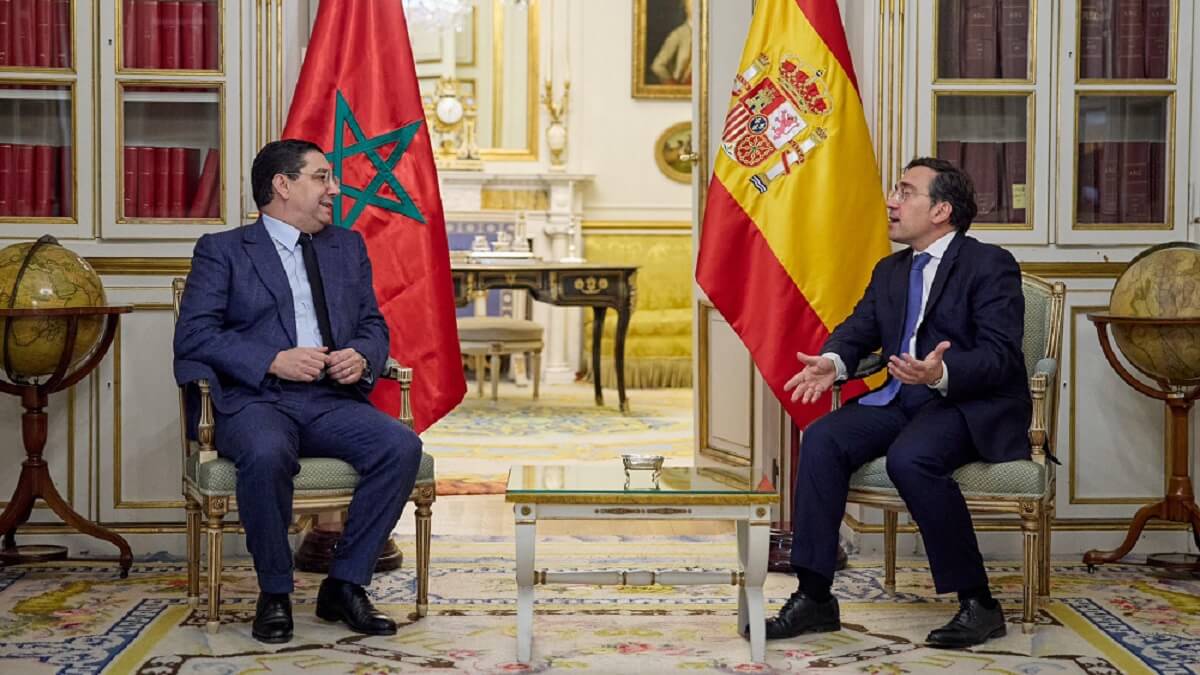
Nasser Bourita and José Manuel Albares – PHOTO/X/@jmalbares
The underlying issue of Western Sahara
Madrid has been the scene of a series of meetings aimed at determining more precisely a solution to the sovereign issue of Western Sahara, based clearly on Morocco’s autonomy plan for the Sahrawi territory, as advocated by the United States, with President Donald Trump at the helm, and after the UN Security Council approved Resolution 2797 last October without any votes against, although with abstentions from China and Russia, presenting the Moroccan autonomy initiative as the most solid basis for finding a rapid solution to the sovereignty of Western Sahara.
Spain already gave its approval to the Moroccan proposal in March 2022, following the announcement by Pedro Sánchez’s government that it considered the North African country’s initiative to be the most serious, credible and realistic option for resolving the Sahrawi dispute.
Morocco presented this autonomy plan to the UN in 2007 and, since then, has garnered the support of more than 100 countries, including powers such as the United States, which gave its backing under Donald Trump’s first government in December 2020, France, the United Arab Emirates, the United Kingdom and Germany.
Morocco’s proposal provides for broad autonomy for the Sahrawis under Moroccan sovereignty, with considerable room for manoeuvre for local authorities and leaving foreign and defence policy in the hands of the Moroccan state. The aim is to develop the Sahrawi territory to its full potential and give it a prosperous future, as Morocco has been demonstrating for some time with its planned investments in the so-called southern provinces.
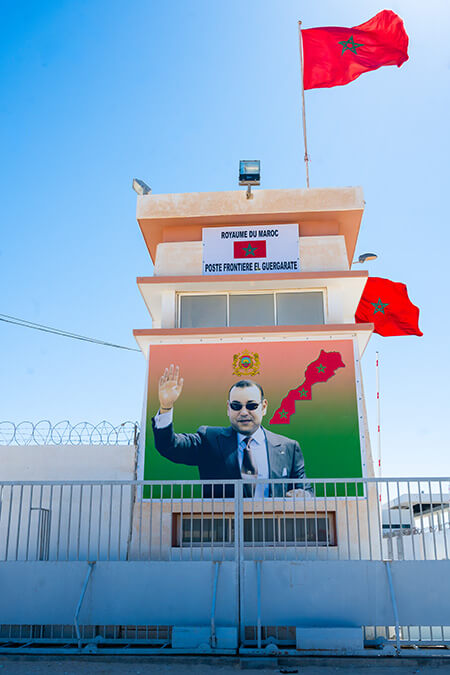
Guerguerat Pass, Morocco – ATALAYAR/GUILLERMO LÓPEZ
Opposing this proposal is the Polisario Front, supported by Algeria, Morocco’s great political rival in the Maghreb, which advocates holding a referendum on independence for the Sahrawi population, which is difficult to achieve, according to various experts, due to issues such as the creation of an electoral roll, given the population dispersion between citizens residing in the current Western Sahara and those living in extreme conditions in the Sahrawi refugee camps set up on Algerian territory.
The United States was heavily involved in promoting the Moroccan autonomy plan in exchange for the Moroccan kingdom’s support for the famous Abraham Accords of September 2020, whereby several Arab countries established diplomatic relations with Israel, a great ally of the US giant in the Middle East, with a view to developing the region to its full potential and promoting peace in the area by confronting destabilising actors such as the Islamic Republic of Iran.
The country led by Donald Trump has continued to show its support over the years for Morocco’s autonomy initiative for the Sahara, including this latest episode of summits held in Madrid to bring the parties involved together and seek a definitive agreement to end the Sahrawi dispute, which has been going on for five decades since the end of the Spanish colonial era.
On Sunday, a technical meeting organised by the US Embassy in Spain was held in Madrid, attended by representatives from Morocco, the Polisario Front and Algeria, as well as neighbouring Mauritania, and Staffan de Mistura, the UN Secretary-General’s personal envoy for Western Sahara. and at which Morocco’s autonomy plan was taken as the main basis for a negotiated solution to the Western Sahara issue. According to various sources, the United States has made it clear that the basis for successfully concluding the negotiations is the Moroccan autonomy plan, a view shared by other actors such as Spain, and that is why work was done on a more technical issue, outside of ideological discussions, to bring positions closer to those of Algeria, which, according to various sources, remained initially unyielding in its defence of the arguments in favour of holding an independence referendum, thus supporting the Polisario Front. The United States also clarified that Algeria is a more involved player in the issue of the resolution for Western Sahara and not a mere observer, given its involvement in the territory and its link with the Polisario Front. In any case, Algeria’s mere presence at this summit in Madrid may mean that the Algerian nation is close to accepting an agreement that could have Morocco’s autonomy proposal as its main basis for reaching a definitive solution for Western Sahara.
The parties involved agreed to create a Permanent Technical Committee. This committee will be composed of legal experts from Morocco, Algeria and Mauritania, under the joint supervision of the United States and the UN. Its mission will be to examine the specific modalities for implementing autonomy in the Sahara, particularly in the areas of taxation, the judicial system and local security.
Meeting with Staffan de Mistura
José Manuel Albares, Spain’s Minister of Foreign Affairs, met in Madrid with Staffan de Mistura, the UN Secretary-General’s Personal Envoy for Western Sahara, before meeting with Nasser Bourita to explore the next solution to the Sahrawi question.
The Spanish minister praised Staffan de Mistura’s efforts to bring about an in-depth political dialogue between the parties involved with a view to reaching a negotiated solution to the Sahrawi dispute. For his part, the UN envoy expressed his confidence and hope that a final agreement would be reached shortly after the important contacts made in Madrid.
Albares with Attaf and Merzoug
José Manuel Albares, Spain’s Minister of Foreign Affairs, also met on Saturday with Ahmed Attaf, Algerian Minister of Foreign Affairs, and his Mauritanian counterpart, Mohammed Salem Merzoug.
José Manuel Albares said he was ‘happy to welcome the Algerian Minister of Foreign Affairs to Madrid. ’We have strongly consolidated political relations of friendship. We are friends, partners and neighbours. Algeria is our leading gas supplier, a strategic, reliable and constant partner,‘ said the Spanish diplomat, who explained that trade relations with Algeria ’are experiencing an extraordinary moment” with Spanish exports growing by 190% in 2025 and 141% in 2024.
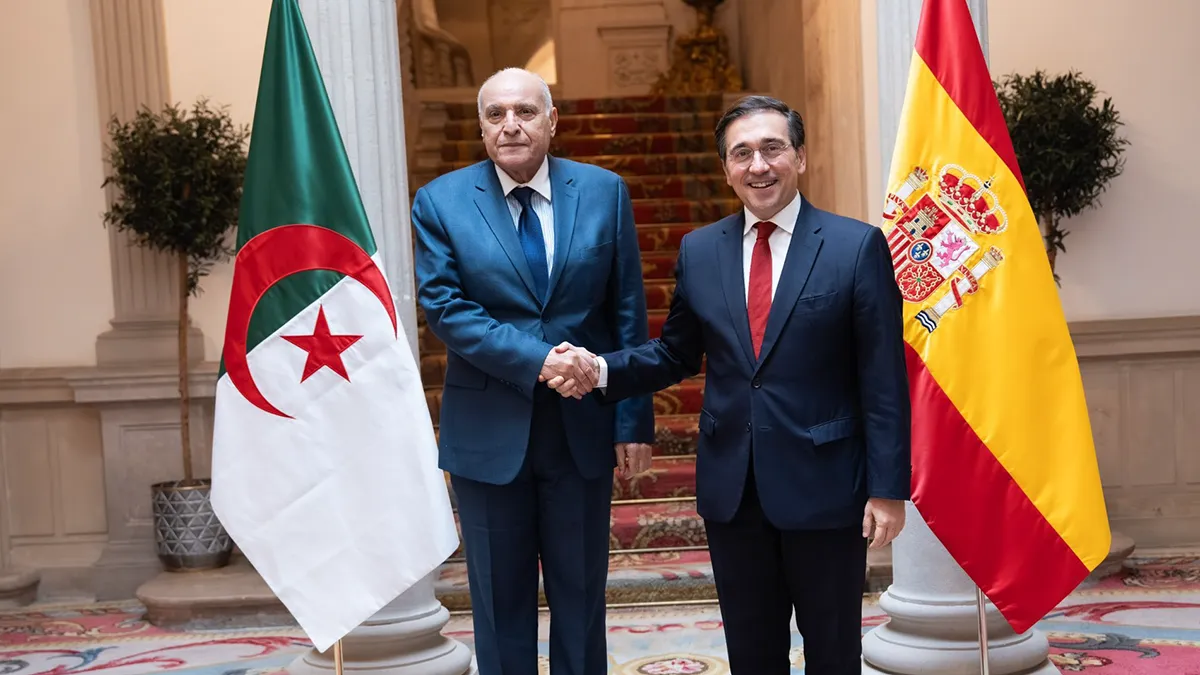
Ahmed Attaf and José Manuel Albares
Regarding the meeting with the Mauritanian Minister of Foreign Affairs, José Manuel Albares noted ‘the progress made in the friendship and cooperation between Spain and Mauritania,’ specifying the commitments made at the 2025 High-Level Meeting.
The Spanish Foreign Minister referred to ‘enhanced cooperation with results in orderly migration and mobility, saving thousands of lives in the Atlantic’ and good economic and trade relations.
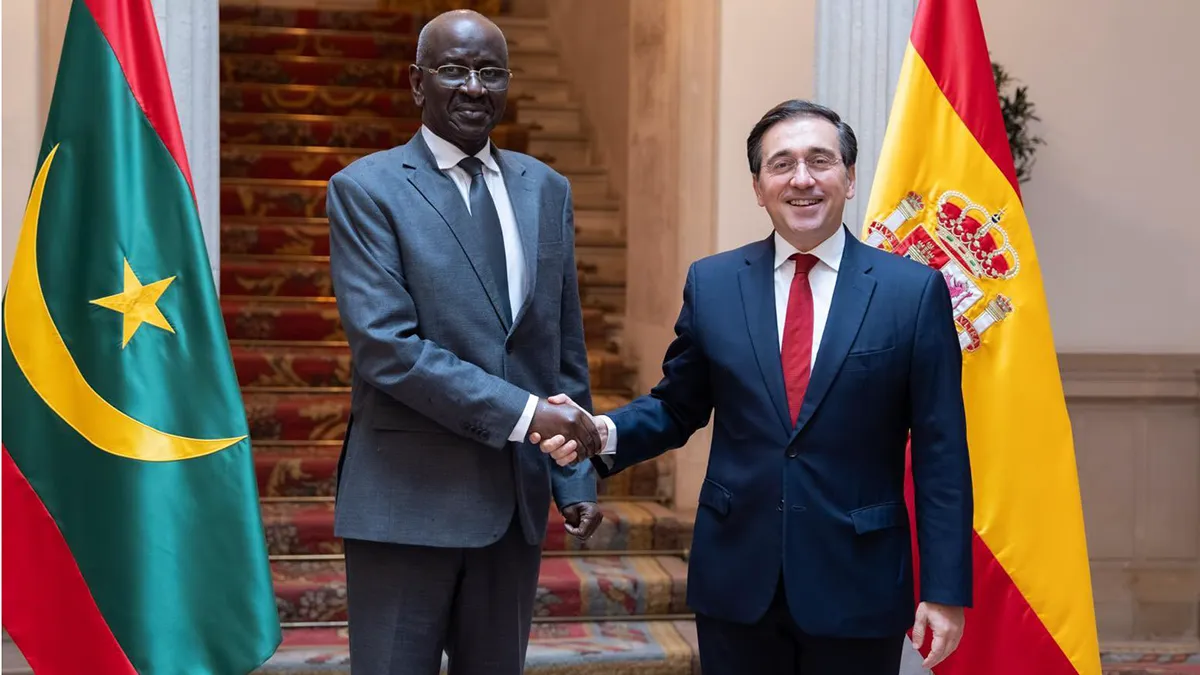
Mohammed Salem Merzoug and José Manuel Albares
‘At the regional level, we are committed to stability in the Sahel and to strengthening EU-Mauritania cooperation. Our joint projects continue, as does the drive towards a stronger and deeper EU-Mauritania partnership,’ explained José Manuel Albares.